Most calls we get about a "broken" electric fireplace turn out to be installation problems, not product defects. If you're installing electric fireplace units yourself, or hiring a contractor unfamiliar with the category, the same five mistakes cause almost every callback: wrong circuit, wrong framing, blocked clearance, wrong room, and unrealistic heat expectations. None of these require special tools to avoid, they just need to be checked before the wall goes back together.
TL;DR
- Electric fireplaces need a dedicated circuit, not just a dedicated outlet. Sharing a circuit with other loads is the most common cause of tripped breakers.
- Framing must match the exact model's manual, not a generic estimate. Different sizes and brands require different rough openings.
- Convective heat vents need 3 feet of clearance from combustibles like curtains and upholstery, even though the glass front stays cool.
- A 120V unit realistically heats about 400 sq ft. Don't plan on it as a primary heat source for a larger room.
What do you need before installing an electric fireplace?
Before cutting into a wall, gather the specific installation manual for your model (not a generic guide), a tape measure, a stud finder, and a level. If the unit will be hardwired or added to a new circuit, you also need a licensed electrician on the project, since electric fireplaces draw enough continuous current that they need their own breaker. Confirm the fireplace's SKU and size before framing anything. Manufacturers change rough opening dimensions between sizes and revisions, and framing to a remembered number instead of the current manual is one of the most common causes of a fireplace that doesn't fit the finished opening.
It also helps to decide upfront whether the unit will be plug-in or hardwired, since that changes what you need on-site. A plug-in install on an existing dedicated circuit is a project most homeowners can finish themselves once the opening is framed. A hardwired install, or any project that requires adding a new circuit at the panel, should go to a licensed electrician, both for safety and because most manufacturers' warranties expect the electrical work to meet local code.
What's the step-by-step checklist for a trouble-free install?
- Confirm the fireplace will run on a dedicated circuit. Standard 120V units draw around 1,500W (about 12.5A) on high heat, which is close to the limit of a 15-amp breaker once anything else shares that circuit. A dedicated 20-amp circuit gives headroom and is what most manufacturers recommend.
- Never install through an extension cord or power strip. Continuous high-amperage draw from a heater can melt the cord jacket and start a fire; the unit needs to plug directly into a grounded outlet or be hardwired.
- Match the rough opening to the current manual for your exact model and size, not a previous project or a similar-looking unit. Framing built for the wrong model is a common reason installers end up re-cutting drywall.
- If you're cutting into a load-bearing wall, add a properly engineered header above the opening before removing any studs. Severing load-bearing studs without a header can cause sagging or structural damage, and it's worth a carpenter's opinion if you're not sure whether the wall is load-bearing.
- Maintain clearance from combustibles. Convective heat vents (usually top or front) need a minimum of 3 feet from curtains, upholstered furniture, and other combustible material, even on units where the glass panel stays cool to the touch.
- If mounting a TV above the fireplace, check the manual for the required gap. A minimum of about 12 inches between the top of the fireplace frame and the bottom of the TV is a common baseline, though the exact number depends on the model.
- Skip bathroom installs unless the specific unit is explicitly rated for damp or wet locations. Standard units have unsealed electronics that can corrode or short out from shower steam.

A built-in electric fireplace framed into a mantel surround, the finished opening matched exactly to the unit's installation manual.
What are the warning signs of a bad installation?
A breaker that trips repeatedly under normal use almost always points to a shared circuit rather than a faulty fireplace. Visible gaps around the frame, a unit that sits unlevel, or trim that doesn't sit flush usually mean the rough opening didn't match the model's actual dimensions. If the unit shuts off unexpectedly during use, check that the intake and exhaust vents aren't blocked by trim, insulation, or nearby furniture, since blocked airflow can trigger a thermal safety shutoff. Any of these is worth resolving before finishing the surrounding wall, since opening it back up later is far more disruptive than fixing it during the initial install.
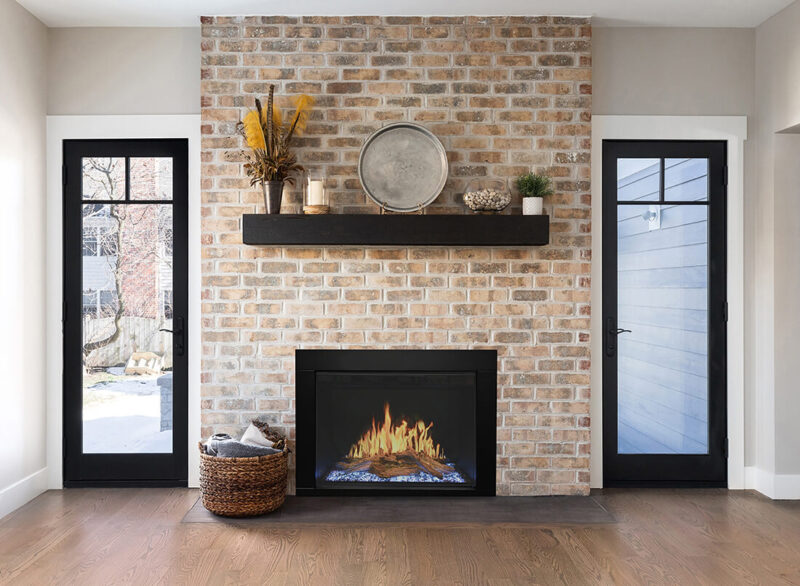
A finished insert installation, sitting flush inside the existing opening with no visible gaps around the frame.
How often should you recheck an electric fireplace installation?
Check the installation again after the first full heating season, since that's when a marginal circuit or clearance issue is most likely to show up under sustained use. Recheck it again anytime you add a mantel, trim, built-ins, or shelving nearby, since new materials placed too close can violate the original clearance even if the initial install was correct. Outside of those triggers, a quick annual visual check, confirming the unit still sits flush, the breaker isn't warm to the touch, and nothing combustible has migrated into the clearance zone, is enough for most households.
FAQ
Can I plug an electric fireplace into an extension cord or power strip?
No. The continuous high-amperage draw of the heater can overheat the cord and create a fire risk. Always use a direct connection to a grounded wall outlet or a proper hardwire connection.
Why does my electric fireplace keep tripping the breaker?
The most common cause is sharing a circuit with other appliances. A standard 120V unit draws close to 1,500W on high heat, which leaves little headroom on a shared 15-amp circuit. Moving it to its own dedicated circuit resolves most tripping issues.
Can I install an electric fireplace into a load-bearing wall?
Yes, but only with a properly engineered header installed above the rough opening to carry the load around the cut studs. If you're not sure whether a wall is load-bearing, have a carpenter or structural engineer confirm before cutting.
How close can furniture or curtains sit to an electric fireplace?
Keep at least 3 feet between the fireplace's heat vents and any combustible material, including curtains, upholstered furniture, and paper goods, even though the glass front itself typically stays cool.
Does an electric fireplace need a vent pipe or chimney?
No. Electric fireplaces don't produce real combustion, smoke, or exhaust gases, so they don't need venting, a chimney, or any exterior wall penetration. This is one of the reasons they're easier to retrofit into an existing wall than a gas unit.
Is it safe to install an electric fireplace in a bathroom?
Only if the specific model is explicitly listed as rated for damp or wet locations. Standard units have unsealed circuit boards and heating elements that can corrode or short out from shower steam over time. Check the product's certification and manual before buying if a bathroom install is the plan.
If you're installing a unit from our built-in electric fireplace collection, always pull the manual for your exact model and size before framing. Installing an insert instead of a built-in unit? The framing and clearance rules differ, our electric fireplace insert collection lists insert-specific installation notes on each product page. Two current models worth checking installation specs on before you buy are the SimpliFire Allusion Slim and the Modern Flames Orion Multi, both of which have published rough-opening dimensions by size.


Leave a comment