
How Do You Maintain a Water Vapor Fireplace?
The full maintenance routine for water vapor fireplaces, from transducer cleaning to troubleshooting a weak or missing flame effect.


Water vapor fireplaces use an ultrasonic transducer to turn water into a fine mist, then light it from below with LEDs to create a flame effect that looks remarkably close to real fire, without smoke, soot, or an open flame. That mechanism is also exactly why they need a different kind of upkeep than a wood or gas fireplace. Skip the maintenance and the symptoms show up fast: a weak or missing flame effect, strange noises, or mineral crust where the mist should be.
TL;DR
The tool list is short on purpose, which is part of the appeal of this fireplace type. You'll want a soft brush (a clean, dedicated toothbrush works well) for the transducer, a supply of water (tap or distilled, depending on your water hardness), a microfiber cloth for the viewing glass and housing, and, when it's time, a replacement bulb that matches the model listed in your unit's manual. No detergents, descaling chemicals, or abrasive pads belong anywhere near the transducer.
Water quality matters more here than with almost any other fireplace type. Manufacturer guidance for ultrasonic models like Dimplex's Opti-Myst line calls for clean, cold tap water in most areas, but recommends switching to distilled water specifically in hard-water regions, since dissolved minerals are what cake onto the transducer and gradually mute the mist effect. Skip essential oils, scented additives, or anything beyond plain water in the tank. Additives can damage the transducer and change how the flame effect behaves. If you're unsure how hard your water is, a cheap test strip from a hardware store settles it in minutes, and erring toward distilled water costs very little compared to replacing a transducer that's been caked with mineral scale for months.

A water vapor insert built into a traditional mantel surround
A weak or missing flame effect is the most common complaint, and it's almost always one of three things: the tank is low or not seated correctly, the transducer needs cleaning, or a connection has come loose. Confirm the tank is full and properly seated, make sure the transducer is clean and connected, then power-cycle the unit. If none of that resolves it, the issue is likely inside the electronics or the transducer itself, which is a job for a qualified technician rather than a DIY fix.
Unusual noises, like a buzzing or rattling sound, usually point to a low water level or a component that isn't seated correctly; check the tank and reseat everything before assuming there's a mechanical fault. If noise continues after confirming water level and seating, that's also a point to contact the manufacturer or an authorized service technician rather than opening up the unit further. Because these are electrical appliances with a water reservoir built in, any sign of water leaking outside the tank, visible corrosion on electrical components, or a burning smell (as opposed to the normal faint scent of new electronics on first use) warrants unplugging the unit immediately and calling for service.
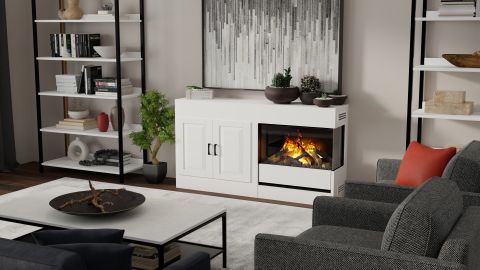
The ultrasonic mist and LED flame effect in a built-in installation
Refilling is the most frequent task by far, typically every 8 to 10 hours of active use, which for most households means every few days. Transducer cleaning should happen on a roughly two-week cycle if the unit runs regularly, though homes in hard-water areas may need to do it more often since mineral buildup accelerates with harder water. Bulb life varies by model, but when the flame effect starts looking dim rather than weak or absent, that's usually a bulb, not a transducer, problem. A full wipe-down of the glass and housing is more about appearance than function and can happen whenever it visibly needs it, typically every few weeks for an actively used unit.
One distinction worth knowing before you buy or maintain one of these: not every water vapor fireplace produces heat. Litedeer's Mercury line, for instance, is built as a heatless ambiance fireplace, while several of Dimplex's Opti-Myst models include a heater as a built-in or optional feature. Check your specific model's listing before assuming it will supplement your room's heating, since the maintenance routine doesn't change but the heater, if present, adds its own filter or vent-cleaning consideration on top of the water-side upkeep described above. Browse The Fireplace USA's full water vapor fireplace collection to compare heated and heatless models side by side.
Clean cold tap water works in most areas. Switch to distilled water if you're in a hard-water region, since dissolved minerals are the main cause of transducer buildup and fading mist output over time.
Roughly every two weeks for regular use, using only a soft brush. Skip detergents and abrasives, which can damage the ceramic disc.
Check three things in order: whether the tank is full and seated correctly, whether the transducer is clean, and whether all connections are secure. Power-cycling the unit after checking those usually resolves it.
It depends on the model. Some, like Litedeer's Mercury line, are heatless and ambiance-only. Others, including several Dimplex Opti-Myst models, include a heater as a standard or optional feature, so check your specific listing.
The full maintenance routine for water vapor fireplaces, from transducer cleaning to troubleshooting a weak or missing flame effect.

Everything to know about the Superior VRL3000 vent-free linear gas fireplace: how it works, who it's for, and how it compares to other options.

{"one"=>"Select 2 or 3 items to compare", "other"=>"{{ count }} of 3 items selected"}
Leave a comment