
How Do You Maintain a Water Vapor Fireplace?
The full maintenance routine for water vapor fireplaces, from transducer cleaning to troubleshooting a weak or missing flame effect.


Both an outdoor gas fireplace and a gas fire table can turn a flat patio into somewhere worth spending the evening. They run on the same fuel, create the same ambiance, and serve the same basic purpose — but the similarities stop there. How they perform, what they cost, and how they fit into a backyard are different enough that choosing the wrong one is a real mistake.
This guide breaks down the outdoor gas fireplace vs gas fire pit table comparison across five factors: upfront cost, running cost, heat output, installation, and maintenance. A summary table and buyer guide at the end help you match the right option to your specific patio setup.
Gas fire tables generally cost less to buy outright. Models like the Outdoor GreatRoom Company Balsam Montego 59" start at $1,899, and most mid-tier rectangular or linear tables land in the $2,000–$3,000 range. Premium dining-height models like the OGC Kenwood 81" Gas Fire Pit Dining Table push toward $3,999 — but that's a table and a fire feature combined in one piece of furniture.
Outdoor gas fireplaces start higher and scale up quickly. The Majestic Courtyard Vent-Free Outdoor Gas Fireplace opens at $2,639, while the Superior VRE3200 runs $3,709 for the 36" opening. Built-in linear models like the Superior Outdoor Linear approach $5,400. Add professional installation, gas line work, and a masonry or prefab surround, and the total project cost for a built-in outdoor fireplace often lands $2,000–$5,000 above the appliance price alone.
Verdict: Gas fire tables win on upfront cost. The unit price is typically lower and the installation is significantly less involved.
Both appliances run on natural gas or liquid propane, so operating cost is a function of BTU output and hours of use. Gas fireplaces in the vent-free outdoor category typically run 45,000–55,000 BTU/hr. At average U.S. natural gas rates (~$1.20/therm), that works out to roughly $0.06–$0.08 per hour.
Gas fire tables often have higher-output burners. The OGC Balsam Montego runs 100,000 BTU/hr — nearly double many fireplace burners — which translates to roughly $0.12–$0.15 per hour on natural gas, or significantly more on propane. Some mid-range tables land closer to 55,000 BTU (like the OGC Providence Rectangular), which brings running cost in line with a comparable gas fireplace.
Verdict: Compare BTU ratings directly. A 55,000 BTU fire table costs roughly the same to run as a 55,000 BTU outdoor fireplace. High-output tables at 80,000–100,000 BTU will cost more per hour.
Raw BTU numbers don't tell the full story — how that heat reaches you depends on the design.
An outdoor gas fireplace concentrates heat forward through the firebox opening. The firebox and surround act as a reflector, pushing radiant heat toward the seating area in front of it. For a defined lounge setup — sofa and chairs all facing the fireplace — this is efficient and intense. It performs noticeably better in colder climates and on exposed patios where wind is a factor.
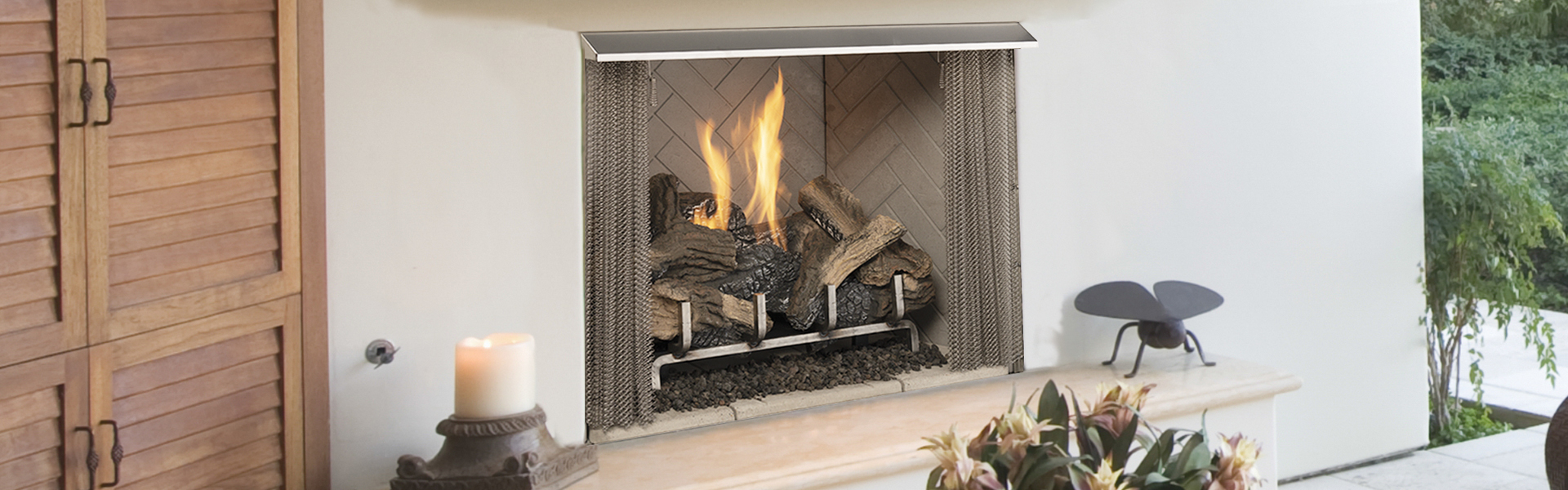
Featured: Superior VRE3200 Vent-Free Outdoor Gas Fireplace
A gas fire table heats 360° — every person seated around the table receives warmth from the burner. The trade-off is dispersal: heat rises from the burner and radiates outward rather than in one concentrated direction. On calm, mild evenings this works well. In cold weather or open, windy spaces, a fire table's ambient warmth falls noticeably short of what a fireplace delivers.
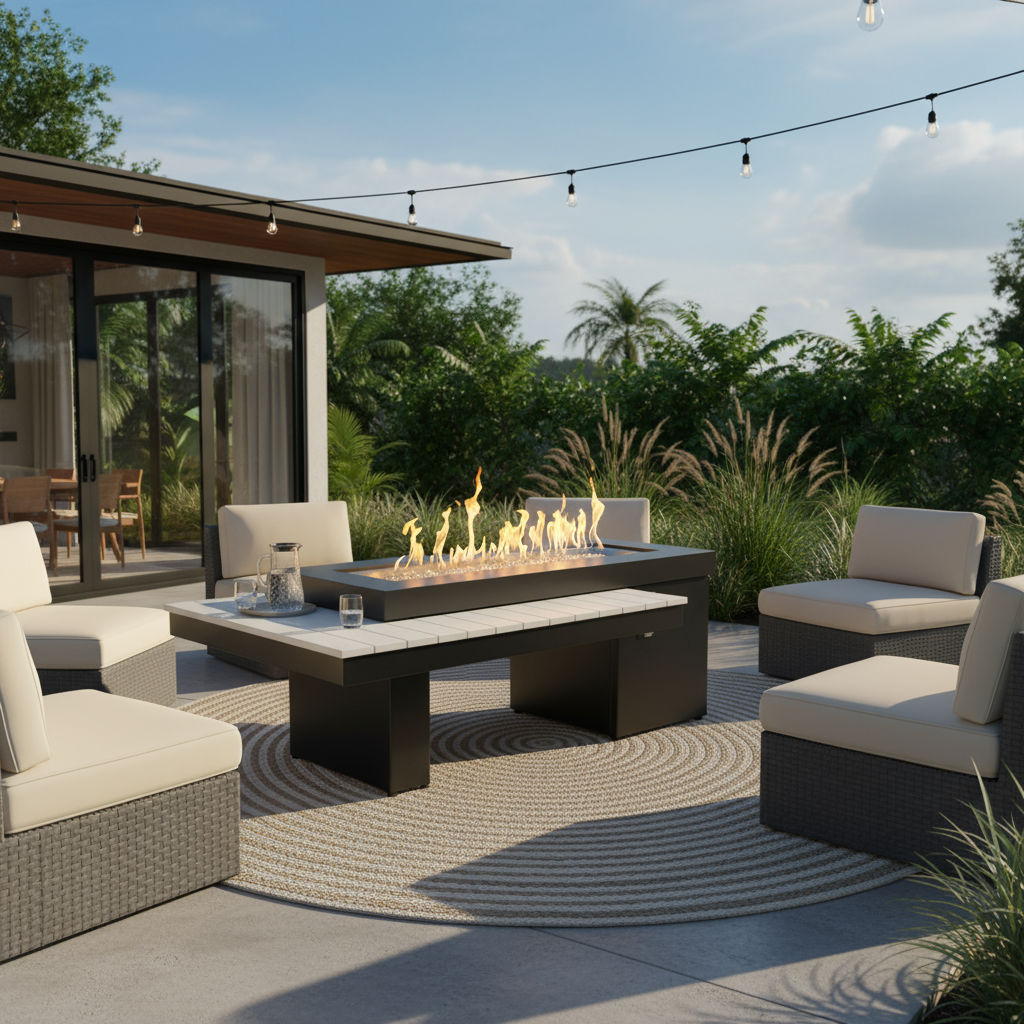
Featured: Outdoor GreatRoom Company Monte Carlo 59" Linear Gas Fire Pit Table
Verdict: Gas fireplaces deliver more focused, intense heat. Fire tables deliver ambient warmth across a larger seating area. Colder climates favor the fireplace; mild climates with open-air social gatherings favor the fire table.
This is where the two products diverge most significantly.
An outdoor gas fireplace is a permanent installation. It requires a fixed gas line run to a specific location, a non-combustible surround (typically masonry, stone veneer, or a prefab metal cabinet), structural footing in some cases, and — depending on your municipality — a permit. Professional installation is standard. Once it's in, it stays. Relocating it next season is not a realistic option.
A gas fire table is far simpler to set up. Most homeowners can place and connect one in an afternoon. If you're running natural gas, a licensed plumber handles the connection. On propane, it's as simple as attaching a tank — many fire tables include a storage compartment built into the base. No surround to build, no structural work required, and no permit in most jurisdictions for a portable propane table.
Verdict: Gas fire tables win significantly on installation — lower cost, less complexity, no permanent commitment to a fixed location.
Neither product demands heavy ongoing maintenance, but there are differences.
Outdoor gas fireplaces require annual burner inspection and periodic glass cleaning on models with viewing panels. Vent-free outdoor models are built to handle weather exposure, but covering the firebox during the off-season extends its lifespan. Gas system components should be checked annually by a qualified technician.
Gas fire tables need occasional cleaning of the fire media — glass fire rocks or lava rock accumulate debris over time and should be rinsed and dried before each season. The burner pan should be inspected annually. The table surface benefits from a weatherproof cover during winter or extended non-use. Propane tanks require monitoring and periodic replacement.
Verdict: Roughly even. Gas fireplaces are slightly more sealed from direct weather exposure. Fire tables have slightly more components to manage — fire media, propane logistics, and surface protection — but nothing that adds up to significant effort.
Choose an outdoor gas fireplace if you are building a permanent outdoor living room, want maximum directed heat output for cold evenings, live in a climate where outdoor temperatures regularly drop below 40°F, or want a hearth-style focal point anchored to a wall or structure.
Choose a gas fire pit table if you want a social centerpiece that seats people on all sides, prefer a lower upfront cost and simpler installation, want propane flexibility for a space without a fixed gas line, or need a single piece that functions as both a table surface and a fire feature.
| Outdoor Gas Fireplace | Gas Fire Table | |
|---|---|---|
| Price Range | $2,639 – $5,389+ | $1,899 – $3,999 |
| BTU Range | 45,000 – 55,000 BTU/hr | 55,000 – 100,000 BTU/hr |
| Heat Direction | Directed forward | 360° ambient |
| Installation | Permanent, professional required | Flexible, DIY-friendly |
| Propane Option | Limited | Yes — most models |
| Best For | Permanent outdoor rooms, cold climates | Social gatherings, mild climates |
Vent-free outdoor gas fireplaces — including the Majestic Courtyard and Superior VRE series — are designed for outdoor use and can typically be installed under a covered patio or pergola. Always verify the clearance requirements in the product manual and confirm local code requirements for covered outdoor gas appliances before installation.
Most gas fire tables require a non-combustible surface or a minimum clearance distance from combustible decking. Some models are rated for use on composite or wood decks with adequate clearance. Check the product's installation manual for minimum clearance specifications before placing a fire table on wood or composite decking.
Permit requirements vary by municipality. Most jurisdictions don't require a permit for a portable propane fire table, but a natural gas connection typically requires a licensed plumber and may trigger a permit requirement. Check with your local building department before installation.
Both are built for outdoor use and can last 10–20 years with proper care. Gas fireplaces have fewer external components exposed to direct weather. Fire tables with powder-coated steel or concrete tops are highly durable, but fire media and burner components may need replacement over time. Using a weatherproof cover extends the lifespan of either product significantly.
Most gas fire tables and many outdoor gas fireplaces are available in both natural gas and liquid propane configurations. Some models ship with a conversion kit. Confirm fuel compatibility at the time of purchase — field conversion is possible on some units but requires an orifice change and should be performed by a qualified gas technician.
The full maintenance routine for water vapor fireplaces, from transducer cleaning to troubleshooting a weak or missing flame effect.

Everything to know about the Superior VRL3000 vent-free linear gas fireplace: how it works, who it's for, and how it compares to other options.

{"one"=>"Select 2 or 3 items to compare", "other"=>"{{ count }} of 3 items selected"}
Leave a comment