
How Do You Maintain a Water Vapor Fireplace?
The full maintenance routine for water vapor fireplaces, from transducer cleaning to troubleshooting a weak or missing flame effect.


Most people buy an electric fireplace when temperatures drop. The reasoning makes sense: wait until you feel the need, then go shopping. The problem is that this puts you in the middle of everyone else making the same decision in September and October, when inventory tightens, contractors book out, and pricing normalizes at or above MSRP across most product lines. Late summer is when conditions for buying an electric fireplace are most favorable, and the case for buying now is straightforward.
Electric fireplace pricing is not as fixed as it looks on a product page. As fall approaches, demand from homeowners, contractors, and interior designers completing renovation projects before winter rises sharply. That shift in demand pressure affects how retailers manage pricing and promotional windows.
Buying in late summer does not guarantee a lower price, but it does mean you are purchasing before seasonal demand builds. The window between Labor Day and Thanksgiving is when this pressure is most pronounced. Models on favorable pricing in August are less likely to hold that pricing through October. A significant portion of this shift comes from freight: large, heavy units become more expensive to ship as carriers approach their busy season, and that cost typically passes through to the final price.
Most electric fireplaces are not shelf items. They ship from distributor warehouses with two to four week lead times under normal conditions. Popular sizes in sought-after lines can sell through quickly once September buying starts. A unit showing available inventory in early August may carry a six to ten week backorder by mid-September.
This matters most for built-in electric fireplaces, where you cannot substitute a different model if your first choice goes on backorder. Once a wall has been framed and cut for a specific firebox depth and width, you are locked into a size range. Inventory delays at that stage stall the entire project.
Some units add outdoor use to the equation, which extends the useful window further. The Amantii Symmetry Bespoke is rated for indoor and covered outdoor installation. Ordered in summer, it can be operational on a covered patio in August before transitioning to an interior focal point once evenings cool. That kind of dual-use value starts in late summer, not in November.
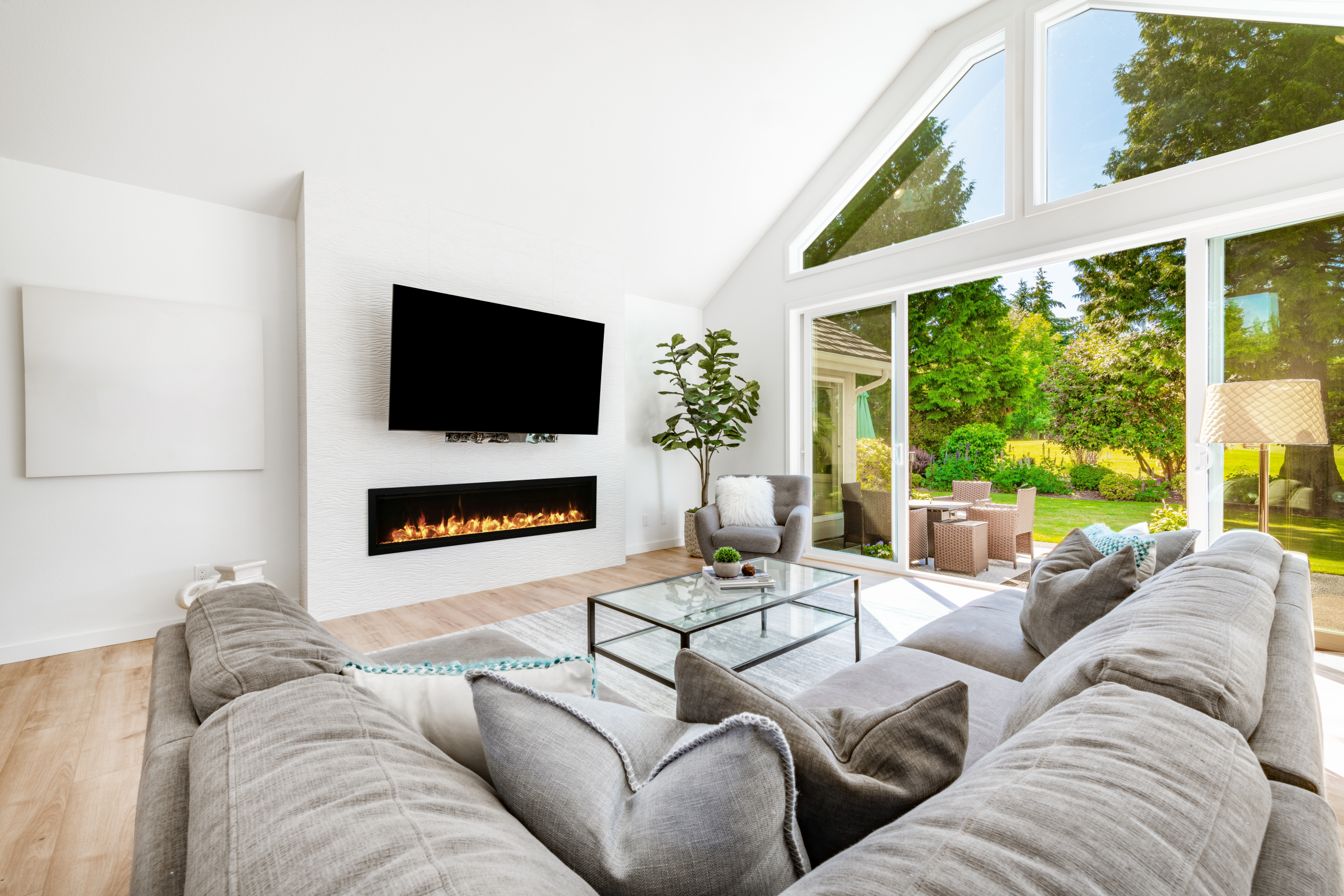
Shown: Amantii Symmetry Bespoke 88" installed in an open-plan living room with garden views
Most built-in electric fireplaces require more than an outlet. Recessed models need wall cutouts framed to exact dimensions. Hardwired units require a dedicated circuit and a licensed electrician. Surround and mantel finishing adds carpentry or drywall work to the scope.
Electricians and general contractors are significantly easier to schedule in July and August than after fall renovation season begins. From mid-September through November, contractors in most markets book two to four weeks out for non-emergency work. A summer installation means your preferred contractor has time to do the work cleanly, without rush scheduling or premium pricing.
The Dimplex Revillusion 36", for example, requires a dedicated 120V circuit and a cutout framed within tight tolerances. That is the kind of job that benefits from a contractor working on a normal timeline rather than a compressed one. Ordering and scheduling in summer keeps that margin in your favor.
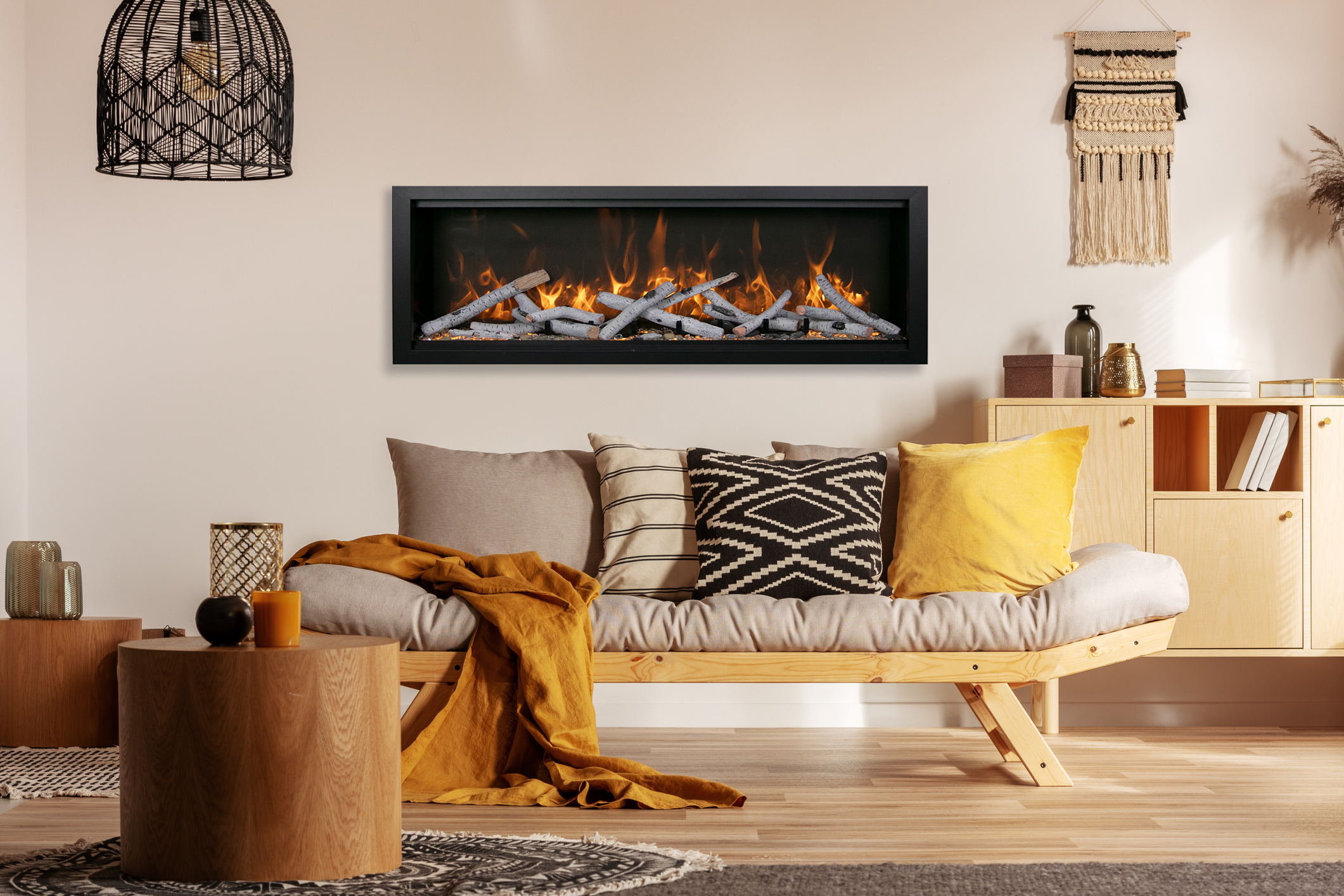
Shown: Amantii Symmetry Bespoke 50" with birch log set in a finished living room installation
Choosing an electric fireplace involves more decisions than selecting a size. You are choosing between built-in and wall-mounted configurations, plug-in and hardwired power, single-sided and multi-sided flame views, and models sized primarily for supplemental heat versus those sized for ambiance where a full heating load is not the goal.
Most buyers also need to account for the finishing approach: whether the fireplace will be surrounded by a full mantel, set into a floating shelf arrangement, or finished flush with drywall. These decisions affect which models are even viable for the space.
Making these decisions under pressure in October, when it is already cold and you want a fireplace this week, leads to shortcuts. Common ones include ordering the closest available unit instead of the right one, skipping a check on cutout depth compatibility, or missing that a specific model requires hardwiring when the room only has a standard outlet. The Modern Flames Redstone 36" is a well-regarded insert option at its price point, but it requires a 20-amp dedicated circuit: the kind of detail that is easy to overlook when you are in a hurry.
Late summer gives you space to get those details right. You can request spec sheets, confirm wall framing dimensions, get an electrician's assessment before placing an order, and compare options across brands without cold weather making the decision for you.
This is the most practical reason to act in summer. If you order in late July and the unit ships within two to three weeks, installation can happen in August or early September. When the first genuinely cool evening arrives, the fireplace is already operational.
The alternative is buying in October when you feel the need. At that point, you are contending with everything described above: tighter inventory, longer lead times, a booked contractor, and the possibility of waiting until late November for an installation slot. By then, a significant portion of the usable heating season has already passed.
Browse the full range of electric fireplaces now, or start with electric fireplace inserts if you have an existing opening to work with.
To make the most of a summer purchase, work through these points before placing an order:
Not always, but it improves your position. Pricing tends to be more stable before fall demand builds, and you avoid contractor premium pricing that comes with scheduling during busy season. The more consistently significant savings come from project efficiency: no delays, no rush fees, no compromising on the unit because your first choice went on backorder.
Plan for two to four weeks minimum from order to delivery for most built-in models, plus time for installation. If your project includes wall framing, electrical work, or a custom surround, add another two to four weeks. Starting in late July or early August gives you a realistic buffer before fall weather arrives.
Plug-in models are generally DIY-friendly. They require a standard outlet and follow the manufacturer's cutout dimensions. Hardwired models require a licensed electrician in most jurisdictions. In either case, the wall cutout and surrounding finish work typically benefit from a professional if you want a clean, flush result.
A common starting point is matching the fireplace width to roughly half the wall it will occupy. Heat output should correspond to the room's square footage, not just the unit's physical size. Most electric fireplaces run the flame display independently from the heater, so you can use the ambiance year-round without adding heat to the space during warmer months.
Yes. Several models in our catalog are certified for indoor installation and covered outdoor use, including covered patios, porches, and overhangs. These are worth considering if your project spans both spaces. Confirm the outdoor rating in the product specs before installation, as coverage requirements vary by model.
The full maintenance routine for water vapor fireplaces, from transducer cleaning to troubleshooting a weak or missing flame effect.

Everything to know about the Superior VRL3000 vent-free linear gas fireplace: how it works, who it's for, and how it compares to other options.

{"one"=>"Select 2 or 3 items to compare", "other"=>"{{ count }} of 3 items selected"}
Leave a comment